
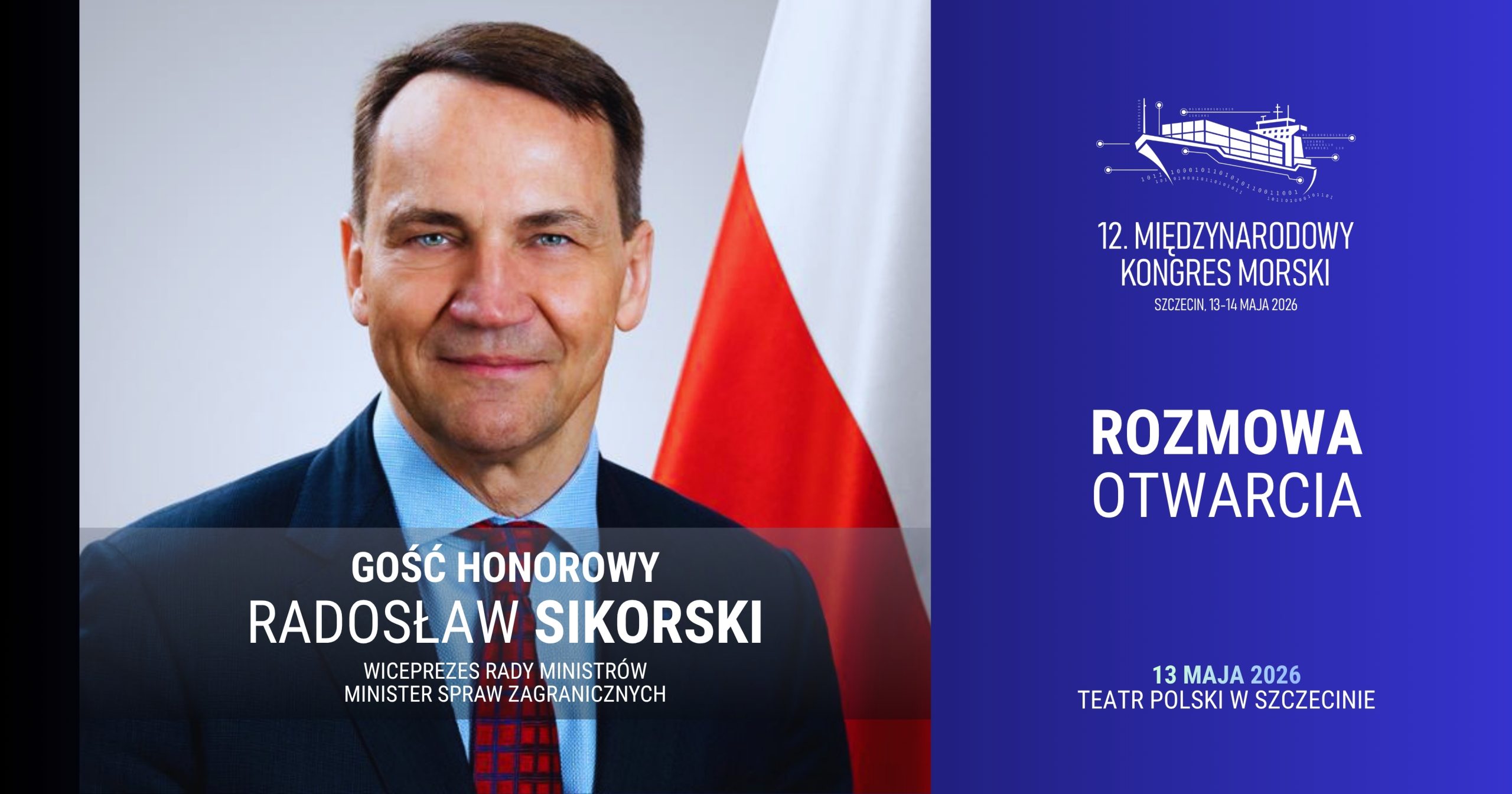
Security, sovereignty, and the future of the maritime economy—these are the three pillars around which this year’s 12th International Maritime Congress will focus. The event, which for years has been one of the most important forums for debate on the direction of the maritime sector’s development in Europe, will begin with an opening address by Deputy Prime Minister and Minister of Foreign Affairs Radosław Sikorski.
The presence of the Polish foreign minister lends this year’s edition of the Congress a special significance—placing the debate on the maritime economy within a broader geopolitical and strategic context. Europe is currently facing a redefinition of its role on the international stage, and maritime security and economic independence are becoming key pieces of this puzzle.
The sea at the heart of the European strategy
In recent years, the importance of the maritime economy has grown significantly. Transport routes, port infrastructure, offshore energy, and maritime safety—all these areas have a direct impact on the economic and political stability of European nations. In the context of geopolitical tensions and growing global competition, the seas and oceans are no longer merely spaces for trade—they are becoming strategic spaces.
The opening discussion with Radosław Sikorski aims to address some fundamental questions: How should Europe build its sovereignty in the maritime domain? What challenges does foreign policy face in the context of trade route security? And finally, how can the potential of the maritime economy be harnessed to build the region’s economic resilience?
Poland in the new security architecture
For Poland, a country of growing importance in the Baltic Sea region, these issues are of particular significance. Port development, infrastructure investments, and the rapidly expanding offshore wind sector are just part of a larger picture in which security and international cooperation play a key role.
The Foreign Minister’s participation in the opening of the Congress underscores the importance of economic diplomacy and the need for close cooperation between foreign policy and the development of strategic economic sectors.
The Congress as a platform for dialogue
For years, the International Maritime Congress has brought together representatives from government, business, academia, and international organizations. This year’s edition promises to be particularly significant—both due to the current geopolitical situation and the growing importance of the energy transition and the digitalization of the maritime sector.
The opening discussion with Radosław Sikorski will mark the symbolic launch of a debate on the future of Europe “on a strategic course”—a course defined by security, sovereignty, and a modern maritime economy.
In the face of rapid global changes, the voices of the political leaders and experts gathered at the Congress may prove crucial to developing a unified European response to the challenges of the coming years.